Tuesday, June 12, 2018

Tuesday, June 12, 2018: Air Pots and Goldfish Stand

One thing I picked up at the MoBot class over the weekend was the potential use of Air Pots. These are peculiar looking pots that MoBot really likes. They supposedly promote good root growth and come in several sizes. This morning I received six one-liter pots.


I transferred five plants I had in either perlite or in soil in other pots.


I also received a stand for one of the goldfish vases. Expecting another stand to be delivered on Thursday.


I also thinned out the carrots and the dill in the west raised bed. They recommended thinning the carrots to one plant every three inches. The dill was recommended one plant every nine inches.


Monday, June 11, 2018

Monday, June 11, 2018: Okra

I took out the second okra plant today. It was only about 4" tall, but we'll see how it does. I still have three more plants still growing inside. The first plant I took out three weeks ago (May 22) is doing well.


The goldfish in my vases are still alive! Tomorrow the second aerator should arrive. I am sharing the one aerator I have between the two vases. Without a doubt, the fish really enjoy the aerator. They seem to enjoy swimming through the bubbles. When I remove the aerator, the fish go mostly dormant. 

Sunday, June 10, 2018

Sunday, June 10, 2018: MoBot, Goldfish

Yesterday I attended a class in plant propagation at the Missouri Botanical Garden (MoBot). There were eight people in the class. The instructor was Justin Lee, one of MoBot's propagators. It seems MoBot has individuals who specialize in propagation of specific types of plants. Justin implied he gets all the weird ones. Interestingly, prior to joining the MoBot, Justin was in IT and never thought he had a "green" thumb. He said his IT background has helped in that exhaustive documentation of everything he does is required. Don't want to repeat mistakes or forget what actually did work well.

The class consisted of about one hour to go over the eight page handout provided, covering the essentials of plant propagation. We then got a tour of the Garden's greenhouses...which was worth the cost of the class on its own. Finally, we got to go into Justin's greenhouse and take some stem cuttings to take home and propagate. I brought home a container with four cuttings. Two different Rosemary's, a succulent and an Acalypha Inferno.


Looking at the MoBot web site, I am assuming the Acalypha is an Acalypha hispida, a native of the South Pacific (New Guinea, Malaysia). MoBot describes its notable characteristics as:

Acalypha hispida, commonly called chenille plant, is a beautiful flowering plant that has a long bloom period. The flowers, which droop in cattail-like pendent clusters up to 18 inches in length are bright red to deep pink. In zones 10 to 11 it is a vigorous, upright, coarse-textured shrub that usually attains a height of 5 to 6 feet that is commonly used as an accent, hedge, specimen or container plant. In St. Louis, it is a good container, hanging basket and greenhouse plant, when taken indoors in the fall. Its long period of bloom makes it a showy centerpiece for any tropical or subtropical garden. It features leaves that are 6 to 8 inches long, ovate and medium green.

It was an interesting class and I took many notes. I need to get some butterwort. These are carnivorous plants that the Garden uses to control gnats which they say are inevitable around indoor plants. I used fly paper this past winter to keep them under control.

This morning I took a cutting off the two fruit trees we have had for several years. I don't know if they are lemon, lime or whatever. But they have never flowered or born fruit. I followed the tips I got from the class yesterday.


The instructor also mentioned the technique of "wounding" a plant to invite new growth. I decided to try this on the Brugmansia. It is now over six feet tall with all the leafing at the very top. I made a wound about 20" above its ground level.

Before wounding

After wounding

A couple of days ago, I decided to try to turn some of our larger flower vases into goldfish bowls. I chose two vases (about 1-1/2 gallon each), put some gravel in the bottom along with some of the aquatic accessories we had in our aquarium down in Lake Jackson. I also put two Marimo Moss Balls in each. I also placed an order for a small aerator which arrived yesterday. I captured one small goldfish from the pond and put it in one of the vases. I wanted to start with just one to see if it would survive at all. After a couple of days, while lethargic, it was still alive. Yesterday, the aerator arrived and I installed it and also added a companion goldfish. The first goldfish took on new life. Not sure if it was due to the aerator or due to having a swimming partner.


 That seemed to go so well, I ordered another aerator (to arrive next Tuesday) and captured two more goldfish for the second vase.


I also replaced the pump in T's gargoyle fountain.


Tuesday, June 5, 2018

Tuesday, June 5, 2018: Last Cactus Flowers

The last two flowers opened on the cactus today. They will be gone by tomorrow.


Sunday, June 3, 2018

Sunday, June 3, 2018: Finally a Spring-like day

We have about three weeks (or less) before Summer begins. Finally, today we had some Spring-like weather. The high today was 84F with a humidity of 30%. Yesterday I brought out the chess pieces.


Today I mowed and trimmed the lawn, cleaned out the garage cutters and weeded the west raised bed. I started the season with low expectations of planting much this years. However, so far, the west bed has kale, basil, dill, leeks, scallions, beets, cabbage and carrots.


The moss balls have finally sunk...after I squeezed the remaining air out of them. I ordered more balls.

The cactus flower lasted one day before it closed again. Today however, two more flowers have opened.


Friday, June 1, 2018

Friday, June 1, 2018: Marimo Moss Balls, Cactus Flower, Cabbage

Another hot day with clear skies. Yesterday I noticed that I might get as many as five flowers on the prickly pear cactus on the east side of the pond.


Today, the first one opened up. They don't last long, but they are very pretty while they last.


Our east neighbor sent me a text yesterday saying that someone had given them a red and green cabbage plant. They are leaving town for awhile and he wondered if I wanted to plant them in our raised bed. I said "of course"! When it cools off a bit later today, I will probably put them in the west raised bed between the kale and the basil. I need to get and plant some marigolds around the perimeter of the bed in a naive attempt to try to keep the rabbits away.


Green and red cabbage
 While planting the cabbage, I noticed a neat row of something on the other side of the drip hose from the basil. I originally thought it might be the Swiss Chard I sowed. Then I also thought it might be the beets I thought I had planted somewhere else. Either way, something is growing in a nice straight line...could be well trained weeds.

Chard, beets or weeds?

I noticed a couple of days ago that I no longer seemed to have any Marimo in the pond. Marimo (毬藻 in Japanese translates literally as "ball seaweed") moss balls are little squishy balls of algae that look a lot like moss, hence the name. In the wild, they roll along the bottoms of rivers, giving them their round shape. They are also viewed as charms in Japan, and even treated as pets. With proper care, Marimo . Benefits (attributes) of the moss balls include:

  • they act like little filters, sucking up debris and small amounts of ammonia and phosphates
  • they suck up CO2 and release oxygen into the water
  • by sucking up the same nutrients as undesirable algae, they deprive invasive algae of those nutrients
  • they harbor significant amounts of beneficial bacteria
  • they are essentially maintenance free
  • they are almost impossible to kill (chlorine will do it)
  • they can survive for over a century (unless eaten)
  • they grow very slowly, only 3/16" (5 mm) / year
  • they do not reproduce
  • goldfish find them tasty
  • they do not produce dead matter
  • critters can use this ball of algae as a smorgasbord, a comfy hiding place, or a means of entertainment

I put 5-10 balls in the pond back in the Spring of 2016 primarily as a secondary source of food for the gold fish while we were on our trips. Well, the fish must have enjoyed them as they are no longer around. I bought some more on-line and they were delivered today. These are "B" grade balls which may be slightly misshapen and may have minor flaws in appearance, but for our pond, they are perfect.


After conditioning them according to the instructions, I put them in the pond. There are 17 balls of various sizes. I'll probably have to dig them out of the skimmer a few times before they hydrate completely and sink to the bottom of the pond.

Marimo Moss Balls

Tuesday, May 29, 2018

Tuesday, May 29, 2018: Okra Saga Continues

The okra plant I took to the garden a week or so ago continues to look healthy. This plant was started inside on January 26 from seed I harvested last Autumn. When I started them, I put a couple of seeds in a 4" pot and also seeds in six sections of peat pot. The one plant I took outside a week ago was from the 4" pot. I repeatedly got seeds in the peat pot to sprout, but they never did much after that. I replanted seeds in the peat pots several times but they never did much.

Progress of okra seeds on March 20
Okra on April 5
Okra transplanted to garden on May 22
I wanted to have three plants again this year. With one in the garden and only one of the many I had planted in the peat pots showing any signs of progress, last week I decided to start some more inside. This time I put three seeds in a larger (4") pot. To my amazement, the seeds in the plastic pot sprouted within just a few days.

Okra on left on May 26
All of this got me to wondering if the problem could be the peat pots. Today, I transferred the one plant still alive in the peat pot to a 6" pot. I left the plant in the peat pot, but tore out the bottom of the peat pot. Considering the growth rate of the plants in the other pot, if the peat potted plant does not take off in a few days, I may cut out the remnants of the peat pot to see if the peat itself is the problem.

Pot on the right has the bottomless peat pot still in it

Saturday, May 26, 2018

Saturday, May 26, 2018: Memorial Day Weekend, rhubarb, dill and basil

Today I took the rhubarb (east raised bed) and basil (west raised bed) I sprouted inside out to the garden. I also sowed some dill in the west raised bed. I also started another pot of basil to keep inside to hedge my bets (I don't know if rabbits will eat the basil or not). While I transferred one okra earlier (looks like it is doing OK so far), the younger okra is not ready to go out just yet. I have one started another batch of okra in a larger pot (they don't seem to do too well in the little peat pots) and they are already sprouted.

Okra on left and basil pot on right

Six basil plants

Three rhubarb plants

Tuesday, May 22, 2018

Tuesday, May 22, 2018: Okra and Spring

Last year I harvested many okra seeds with the hope I could start them inside and take them into the garden. I probably planted two dozen seeds in peat pots earlier this year. Over half of the seeds sprouted, but only one survived to be about six inches tall. Today, I took that one out to the garden.


I was hoping to plant three plants and I'm still trying to inside. I've planted three plants each of the past two years and ended up freezing and giving away many okra.

I had ordered some rhubarb seeds and have them potted inside. I am hoping to plant four additional plants this Spring.
Rhubarb from purchased seeds (looks like one has croaked)
The one plant outside that we have had for 4+ years has gone to seed with an abundance of seeds on it. I will try starting some of them. Rhubarb takes a season or two before it ready for harvest.

4-5 year old Rhubarb gone to seed

Rhubarb seeds
Looking around the garden on this bright Spring day...

Roses are doing well. I pruned them in April

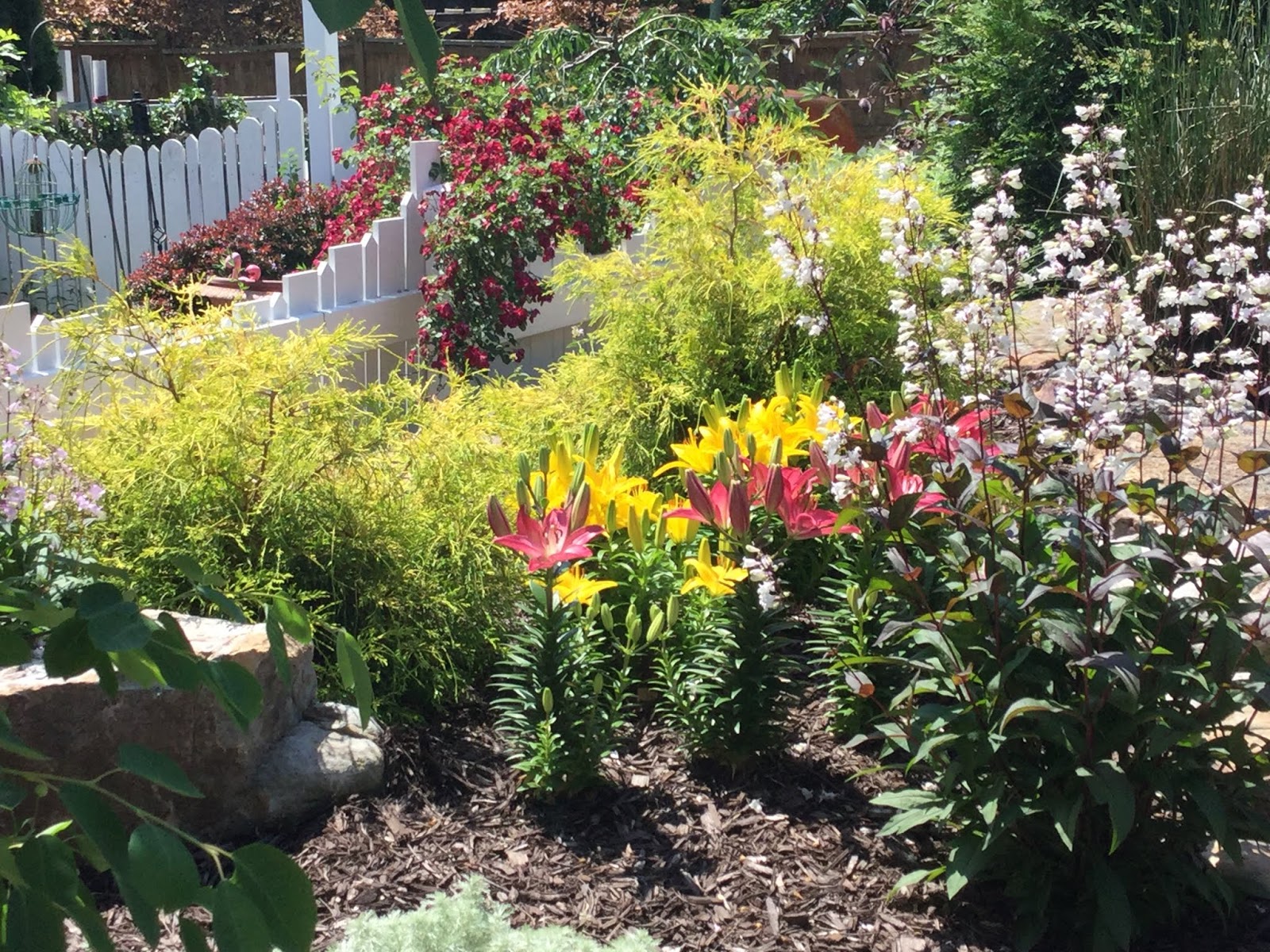
Asiatic Lilies will have a lot of blooms soon.

I thought the Bleeding Heart had died last year, but there it is.

May Apple looks good

Succulents appear to have survived the move outside

Carrots or Beets

Kale

Leeks
None of the three dozen pepper plants survived the last freeze. I waited longer this year to take them outside, but not long enough. I planted both carrots and beet seeds. One of them is going well and no sign of the other. I also planted some Swiss Chard without success.