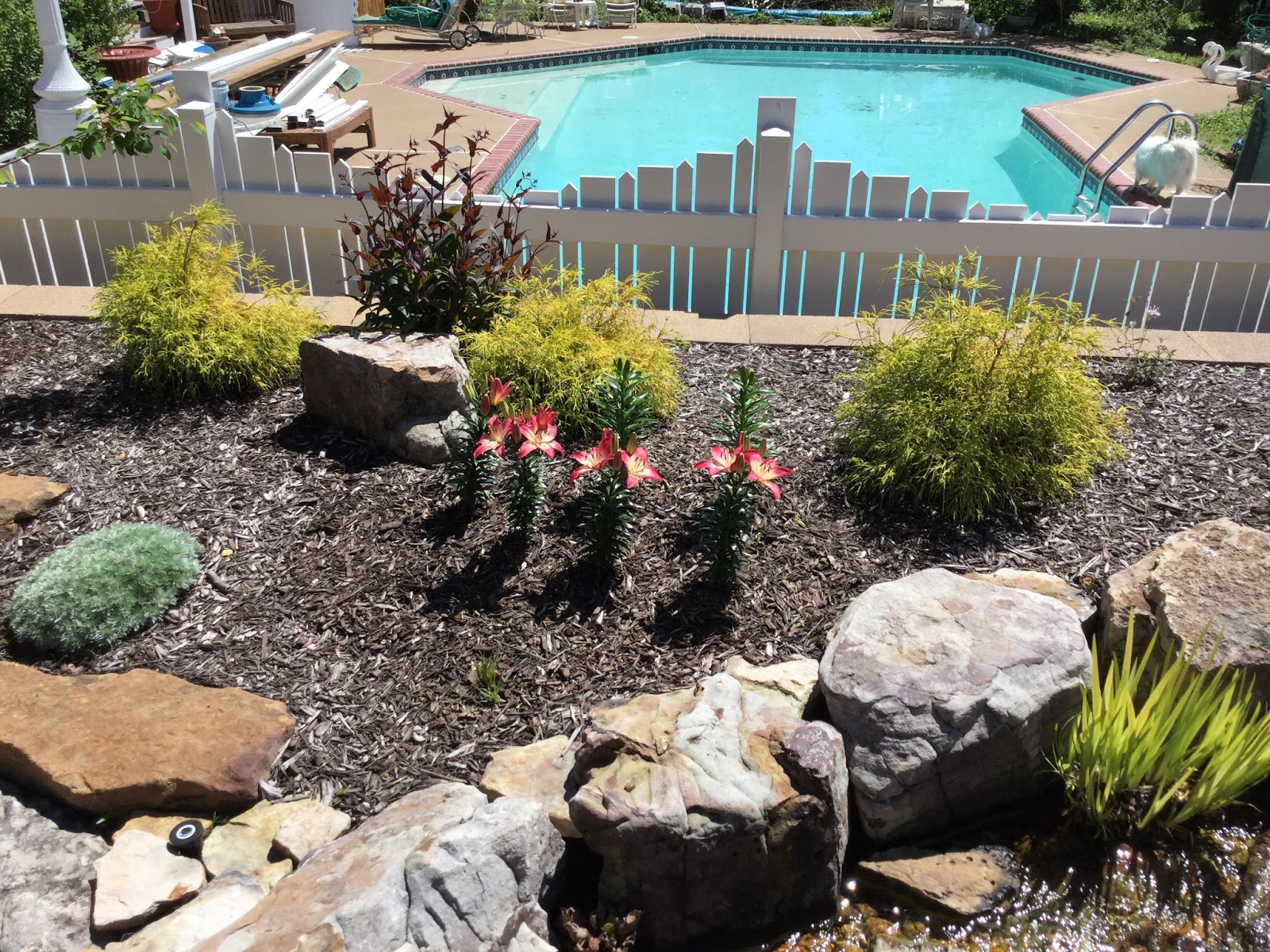
I've been out of town for a week. The garden seems to have fared pretty well although it is obvious that some "mischief" took place around the pond. All of the chess pieces are still here and only a couple were knocked over (wind). However, one of the two iris's in the stream between the upper and lower ponds had been physically moved to the upper pond. The pot of carnivorous plants I had in the stream had been totally emptied out. The accent light in the upper pond had been knocked out of its normal position. The iris in the lower pond was displaced and on its side. I cannot attribute any of this to "wind" action. The most perplexing is the iris being moved from the stream to the upper pond. Not a small plant! If not for this, I might think perhaps the ducks, which visited us last summer, had returned and were frolicking about.
The other iris in the stream has blossomed with deep purple (?) flowers. I hope the other one recovers.
I have a lot of weeding to do, but the okra and pepper plants I planted last week seem to still be alive. The rain gauge showed an accumulation of 1.5" over the past week. There was a severe storm warning in the area Friday morning, so most of that might have been collected over the past day or so.
Looking around the rest of the yard, the neighbor's pool is a nice green color. They appear to be out of town.
The foxglove behind the False Cyprus has bloomed nicely and the last two Asiatic lilies have bloomed.
The Irish and Scottish mosses I planted this spring are still alive and actually have some tiny flowers on them.
The hollyhocks by the east porch, the ones I thought would not survive due to their shaded environment, are doing well.
But not nearly as well as the ones on each end of T's rose bed. The east one, the one I started from seed, is actually blooming. The first to bloom. It is almost six feet tall.
Only one of the two carnations has survived.
The Virginia Sweetspire is blooming.
The Livingstone daisy is still looking OK, but has not spread much since I move it outside a couple weeks ago.
Interestingly, the leeks have sprouted seed pods...I think. I need to research these a bit.
Inside, the poinsettia looks OK, but is ready for a watering. The peace lily however looks critical. Hopefully it will recover.
Saturday, May 20, 2017
Wednesday, May 10, 2017
Wednesday, May 10, 2017; Marigolds, okra and Skimmer Level
I took my weekly walk through the Missouri Botanical Garden (MoBot) this morning. I noticed in their vegatable garden, they had their kale, chard and lettuce beds ringed with both marigolds and impatiens. Last year, after the rabbits started chewing on our Swiss Chard, I planted marigolds and we had no other issues all summer long. Looking on-line today, many sites down play the notion that marigolds will repel rabbits.
Anyway, I stopped by the local Lowe's and picked up 24 marigolds (12 of two different colors) which I brought home and used to ring the area where I have planted the Swiss Chard. Even if the marigolds don't repel the rabbits, maybe their appetite will be satisfied before they reach the chard.
I also picked up some 1/2" PVC fittings so that I can relocate the water level valve in the pond skimmer. Its current position is on the pond side of the screen, is not amendable to being adjusted and holds the water level too high. The new arrangement moves the float into the skimmer chamber where the pump is located, which eliminates the potential for the pump to lose suction just due to plugging of the skimmer screen. It is also holds a lower pond level and makes possible small adjustments to the level to be maintained.
I was planning to wait until I returned from Houston at the end of next week before I planted the okra outside, just to be sure it did not get too cool for them. I went ahead today and planted all three. I put them in the same general area we had the ones last year that yielded so much fruit.
Anyway, I stopped by the local Lowe's and picked up 24 marigolds (12 of two different colors) which I brought home and used to ring the area where I have planted the Swiss Chard. Even if the marigolds don't repel the rabbits, maybe their appetite will be satisfied before they reach the chard.
I also picked up some 1/2" PVC fittings so that I can relocate the water level valve in the pond skimmer. Its current position is on the pond side of the screen, is not amendable to being adjusted and holds the water level too high. The new arrangement moves the float into the skimmer chamber where the pump is located, which eliminates the potential for the pump to lose suction just due to plugging of the skimmer screen. It is also holds a lower pond level and makes possible small adjustments to the level to be maintained.
I was planning to wait until I returned from Houston at the end of next week before I planted the okra outside, just to be sure it did not get too cool for them. I went ahead today and planted all three. I put them in the same general area we had the ones last year that yielded so much fruit.
Tuesday, May 9, 2017
Tuesday, May 9, 2017: Chard and Lilies
Around 90F today. Clear with a slight breeze.
I decided to try planting some more Swiss Chard. In March I planted two rows of different varieties. Today I planted 12 seeds, three inches apart between the previous two rows. The variety I planted was the "Ruby". Optimistically, tomorrow I will go out and get some Marigolds (rabbit deterrent).
The foxglove is blooming nicely.
So is the common sage.
The Purple Fountain beech has leafed out and the leaves are a deep dark color.
Today I read a bit on the Peace Lily (Spathiphyllum) we received late last year. Like the Poinsettia, there is no reason it cannot persist. The Farmer's Almanac says typically they will grow to 16" tall, but the "larger" ones can reach six feet tall. The Almanac recommended re-potting every spring. So, I did so, using a slightly larger pot and adding some potting mix. It seems to be quite happy in its location up on the hot tub deck.
I decided to try planting some more Swiss Chard. In March I planted two rows of different varieties. Today I planted 12 seeds, three inches apart between the previous two rows. The variety I planted was the "Ruby". Optimistically, tomorrow I will go out and get some Marigolds (rabbit deterrent).
The foxglove is blooming nicely.
So is the common sage.
The Purple Fountain beech has leafed out and the leaves are a deep dark color.
Today I read a bit on the Peace Lily (Spathiphyllum) we received late last year. Like the Poinsettia, there is no reason it cannot persist. The Farmer's Almanac says typically they will grow to 16" tall, but the "larger" ones can reach six feet tall. The Almanac recommended re-potting every spring. So, I did so, using a slightly larger pot and adding some potting mix. It seems to be quite happy in its location up on the hot tub deck.
Monday, May 8, 2017
Monday, May 8, 2017; Peppers and Leeks
It appears that NONE of the 15 peppers, NONE of the Swiss Chard, NONE of the kale and NONE of the scallions I planted outside on March 18 have survived. I fear I transplanted everything a bit too soon. I replanted more peppadew seeds inside today. All but one of the ones I planted before sprouted.
Last week I found some okra but was warned not to plant outside yet as it still gets too cool at night. I think I will not take them outside until I return from Houston next week. I also picked up six jalapeño plants which I did plant today. They are five or six inches tall and one already has a blossom.
The leaks we planted in the Spring of 2016 have survived the winter and today, I harvested two leeks to see if they are worth eating. We planted both leak plants and leak seeds. The plants were about the diameter of a pencil, now they are over 1" in diameter. The plants originating from seeds have not grown to nearly the size of the ones from plants. In fact the plants from seeds look more like scallions.
Update on the poinsettia plant that I received from out west neighbors last Christmas and I severely pruned back on March 30, leaving only eight leaves. As hoped, it has leafed out nicely with dozens of new leaves. According to my research, I will pinch the growing tips back by an inch or so in late June to further encourage branching. Then in early September I will prune it again.
The Peace Lily I received from my younger brother last year is, amazingly, still alive and seems to be happy. It needs frequent watering.
Once again today I noticed a rabbit in the east raised bed. I went out and asked the rabbit to leave. It did but a few minutes later, it was back. This time I noticed the rabbit was carrying a batch of grass in it mouth and that it essentially disappeared in the growth of thyme. Going out again, the rabbit dropped its mouthful of grass and left again. I looked and found that it was preparing a burrow underneath the thyme. I tried to back fill the hole. A few minutes later, here was the rabbit again with another mouthful of grass. This time, after chasing "her" off, I built a bamboo fence along the mouth of the would be burrow. This really rubs salt in the wound of having raised beds to make them rabbit-proof. Not only can they access it, but they were building a home in the raised bed. Last year, I planted marigolds which seemed to protect the swiss chard from the rabbits. I don't think either the peppers or the okra will be bothered by the rabbits, but if I do plant some more chard, I will need to get more marigolds.
Last week I found some okra but was warned not to plant outside yet as it still gets too cool at night. I think I will not take them outside until I return from Houston next week. I also picked up six jalapeño plants which I did plant today. They are five or six inches tall and one already has a blossom.
| Jalapeño |
The leaks we planted in the Spring of 2016 have survived the winter and today, I harvested two leeks to see if they are worth eating. We planted both leak plants and leak seeds. The plants were about the diameter of a pencil, now they are over 1" in diameter. The plants originating from seeds have not grown to nearly the size of the ones from plants. In fact the plants from seeds look more like scallions.
| Leak from plant |
| Leak from seed |
| After pruning on March 30 |
| Today |
| Peace Lily |
| Rabbit burrow under thyme |
Saturday, May 6, 2017
Saturday, May 6, 2017; Hornbeams
A beautiful day. Mostly clear with a gusty breeze and highs in the low 70's. Today, the hornbeams along the east fence line were the center of attention. These hornbeams are Carpinus Betulus ‘Frans Fontaine’, a variety of European hornbeam, part of the birch family. They are known for their columnar shape and are a favorite for those wanting to create a hedge. Our overall plan is to create a 12 foot tall hedge. Last fall, I began pleaching (interlacing) the trees. The trees are on five foot centers. While considered a columnar tree, if left on its own, these trees can ultimately grow to 50 feet tall and 20 foot diameter. However, it is relatively slow growing, reaching 25 feet tall and six feet diameter after 10 years.
They were planted in late November 2015 and were probably around 10 feet tall when planted. This Spring, they are up to about 15 feet and starting to look at little "leggy".
I've been reading several guides on the best time to prune these trees and how tall we really wanted them to be. The answer to the second question turned out to be pretty easy. They will be no taller than I can reach using an 8-foot step ladder (which turns out to be about 12 feet). As for when to prune, the answers ranged from early Spring to early summer to "whenever you have the urge to do so". I liked the later suggestion the best. All suggested that by pruning, you encourage additional branching.
After a coupe of hours, I called it good.
They were planted in late November 2015 and were probably around 10 feet tall when planted. This Spring, they are up to about 15 feet and starting to look at little "leggy".
I've been reading several guides on the best time to prune these trees and how tall we really wanted them to be. The answer to the second question turned out to be pretty easy. They will be no taller than I can reach using an 8-foot step ladder (which turns out to be about 12 feet). As for when to prune, the answers ranged from early Spring to early summer to "whenever you have the urge to do so". I liked the later suggestion the best. All suggested that by pruning, you encourage additional branching.
After a coupe of hours, I called it good.
Friday, May 5, 2017
Friday, May 5, 2017; Grout
Yesterday we received three more inches of rain. The total for the last seven days is 10". Today (and hopefully for the weekend) it is sunny and clear.
Last year I noticed that the grout at the northwest corner of the chess board was failing. This corner has the widest joints due to the fact that the people who poured the sidewalks did not make the corner exactly square. The polymeric sand used as grout is supposed to be able to handle joints up to 1" wide. This corner is probably pretty close to that limit.
The chess board pavers are two inches thick and mounted on a sand bedding. My concern was that the rain water would begin to undermine the sand bedding. I have some of the grouting sand that the installer used originally so today, I dug out the failed grout and installed some new, following the bag instructions as closely as possible.
I first dug out the failed grout. The joint is wide enough that I could feel the lower edge of the paver. In one area, there was indeed a void going under the paver. I used the excavated sand to fill this void.
Incrementally, I filled the joint with the polymeric sand, stopping to compact the sand with a wooden dowl. Once the joint was filled, I followed the instructions to gradually mist the joint so that it would harden. Supposedly it will cure in an hour.
Don't know if it will last, but it has got to be better than it was.
The water iris in the lower pond is blooming. The two others (different variety), in the stream between the upper and lower ponds, show no signs of blossoms yet.
Last year I noticed that the grout at the northwest corner of the chess board was failing. This corner has the widest joints due to the fact that the people who poured the sidewalks did not make the corner exactly square. The polymeric sand used as grout is supposed to be able to handle joints up to 1" wide. This corner is probably pretty close to that limit.
The chess board pavers are two inches thick and mounted on a sand bedding. My concern was that the rain water would begin to undermine the sand bedding. I have some of the grouting sand that the installer used originally so today, I dug out the failed grout and installed some new, following the bag instructions as closely as possible.
I first dug out the failed grout. The joint is wide enough that I could feel the lower edge of the paver. In one area, there was indeed a void going under the paver. I used the excavated sand to fill this void.
Incrementally, I filled the joint with the polymeric sand, stopping to compact the sand with a wooden dowl. Once the joint was filled, I followed the instructions to gradually mist the joint so that it would harden. Supposedly it will cure in an hour.
Don't know if it will last, but it has got to be better than it was.
The water iris in the lower pond is blooming. The two others (different variety), in the stream between the upper and lower ponds, show no signs of blossoms yet.
Wednesday, May 3, 2017
Wednesday, May 3, 2017; Rain
It has been raining lightly all day long. It is about 3:00 pm and we have accumulated another 0.75". It is not raining right now, but the forecast is for rain until 9:00 pm tonight.
I got a call from our east neighbor (Morgan) around 2:00 pm. He said a neighbor was wanting to get rid of a prickly pear cactus and wanted to know if I might be interested. I said "OF COURSE". We went over to the neighbor and brought home the plant. It needs some care, but lots of potential.
Tuesday, May 2, 2017
Tuesday, May 2, 2017: OKRA!
We accumulated 7" of rain over the weekend! It sprinkled most of the day yesterday (Monday) but little additional accumulation. Today is sunny and breezy. Tomorrow more rain expected with estimates of another 1" to 3". Lots of river flooding in the region, but we are high and dry. I got the lawn mowed between showers yesterday. The garden seems to have weathered the weather in fine shape. Even the succulent bed seems to have drained well.
All of T's roses are now in bloom. The four new ones are significantly smaller than the one she planted last year. All of these will supposedly reach a height of three feet. The hollyhocks, on each end of the roses are really thriving. Hopefully we will see some blooms this year.
While they did not bloom last year, the foxgloves are starting to bloom this year.
The Asiatic lilies I planted last week are starting to bloom as well.
Today I went once again to the Garden Heights nursery hoping they had received the okra. I could not find any and finally resorted to asking. Sure enough, they did have a few. The guy said it is still to cold at night to leave them outside and suggested keeping them inside until next week. I bought three plants and also got six jalapeno peppers. All of the peppers I started inside and put out about a month ago appear to have failed. Since none have survived, I obviously put them out too soon. None of the chard or kale has shown up either.
The Okra is a Clemson spineless. Not sure what kind we had last year, but we had two plants which generated a lot of fruit.
I am so happy the mayapple is doing so well. I will be checking it frequently for seeds for propagation.
Today I sprayed Roundup on the alley from our west boundary all the way east to the judge's garage. It looks like it may be time to reapply some Snapshot.
All of T's roses are now in bloom. The four new ones are significantly smaller than the one she planted last year. All of these will supposedly reach a height of three feet. The hollyhocks, on each end of the roses are really thriving. Hopefully we will see some blooms this year.
While they did not bloom last year, the foxgloves are starting to bloom this year.
The Asiatic lilies I planted last week are starting to bloom as well.
Today I went once again to the Garden Heights nursery hoping they had received the okra. I could not find any and finally resorted to asking. Sure enough, they did have a few. The guy said it is still to cold at night to leave them outside and suggested keeping them inside until next week. I bought three plants and also got six jalapeno peppers. All of the peppers I started inside and put out about a month ago appear to have failed. Since none have survived, I obviously put them out too soon. None of the chard or kale has shown up either.
The Okra is a Clemson spineless. Not sure what kind we had last year, but we had two plants which generated a lot of fruit.
I am so happy the mayapple is doing so well. I will be checking it frequently for seeds for propagation.
Today I sprayed Roundup on the alley from our west boundary all the way east to the judge's garage. It looks like it may be time to reapply some Snapshot.
Tuesday, April 25, 2017
Saturday, April 22, 2017
Saturday April 22, 2017 Trees and Evergreens
When I was out last week I picked up more fertilizer spikes for the trees and a different version for the evergreens. Today, I put in four spikes around the junipers along the east fence line, two around the southwest holly, two around the red maple on the west fence and two around the Canadian Cherry. I'll put more spikes in this fall.
I spent more time working to eradicate the spearmint from the east raised bed. It appears the work I did a week or so ago was effective although a little has grown back. This stuff is very tenacious.
I cleaned out some of the plugged sprinkler heads. I need to make a comprehensive survey of what changes I want to make to the sprinklers so I can get the proper parts. I am considering taping into the irrigation piping near the pond skimmer and running a line over to the level valve I installed in the skimmer. It would only have water available when that zone of the irrigation system is "active" (probably only 15 minutes, two or three times per week), but that should be enough to keep the water level in a reasonable range.
Absolutely no activity on the vegetables I planted earlier. Not ready to give up yet, but maybe I put them out too soon. There still are no okra at any of the nurseries yet.
All of the roses in T's rose garden are now in bloom along with the columbine. The hollyhock at each end of the garden have leafed out nicely, but so far, no blossoms. I think it is a little too early yet. Same for the foxglove.
I pruned back the common sage and thyme today. The sage has a lot of buds on it. Should bloom later in the Spring.
I spent more time working to eradicate the spearmint from the east raised bed. It appears the work I did a week or so ago was effective although a little has grown back. This stuff is very tenacious.
I cleaned out some of the plugged sprinkler heads. I need to make a comprehensive survey of what changes I want to make to the sprinklers so I can get the proper parts. I am considering taping into the irrigation piping near the pond skimmer and running a line over to the level valve I installed in the skimmer. It would only have water available when that zone of the irrigation system is "active" (probably only 15 minutes, two or three times per week), but that should be enough to keep the water level in a reasonable range.
Absolutely no activity on the vegetables I planted earlier. Not ready to give up yet, but maybe I put them out too soon. There still are no okra at any of the nurseries yet.
All of the roses in T's rose garden are now in bloom along with the columbine. The hollyhock at each end of the garden have leafed out nicely, but so far, no blossoms. I think it is a little too early yet. Same for the foxglove.
I pruned back the common sage and thyme today. The sage has a lot of buds on it. Should bloom later in the Spring.
Subscribe to:
Posts (Atom)